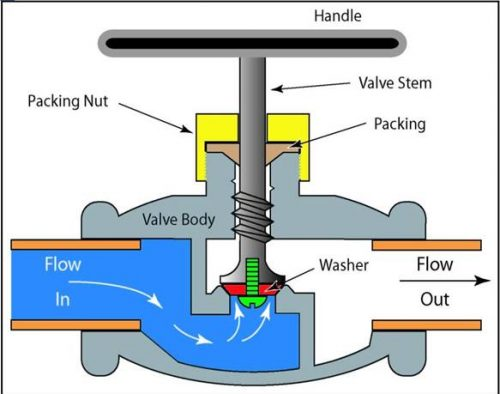
The flange globe valve consists of the body, bonnet, and handwheel. The bonnet holds the stem. The stem is turned using the handwheel. This makes the stem rise upwards and downwards through screw threads. The stem end part consists of plugs or discs. These discs are metallic or non-metallic and have different shapes depending on intended valve usage. The valve seat is mounted within the globe-shaped body. The seat divides the body into two chambers. The seat is made with a hole to allow the passage of fluid. When the valve is opened, the fluid flows up through the opening into the valve seat. To stop the fluid flow, the stem is screwed down till the seat opening is blocked using the disc. Also, a flange globe valve is used to modulate fluid flow. It modulates the flow by partially opening and adjusting the flow without terminating it. In flange globe valves, pressure loss occurs because the fluid meets some resistance due to friction, turbulence, and gravity. Loss in pressure and turbulence occurs because the valve forces the media to change flow direction. The pressure loss in the flange globe valve depends on the amount of friction during fluid flow.
Components of flange globe valve
Valve body
The valve body is the main component of a flange globe valve as it is the component that keeps all the other parts together. The valve body houses all the internal parts of a flange globe valve to enhance fluid control. The valve body contains the ports that facilitate fluid flow in or out of the valve. The main feature of the valve body is high strength to ensure it can withstand high pressure and temperatures emanating from fluid flowing. Such strength depends on the material used to make the valve body. Some of the strong materials used to make the valve body include stainless steel and cast iron.
Seat/seat ring
The seat is one of the components of the flange globe valve used to seal the area between the stem and bonnet. The seat ring is screwed or torqued into the valve. The seat ring is used to provide a stable and replaceable shutoff surface.
Bonnet
Bonnet is one of the exterior components of the flange globe valve. The bonnet is connected to the valve body to ensure there is leak-proof closure. The bonnet type can be screw-in, union, or bolted.
The union bonnet is used to enhance strength and also makes it easier to do regular inspection and cleaning. The screw-in bonnet is of simple design and provides a pressure-tight seal to the valve body. The bolted bonnet, as the name suggests, is fixed in its position using bolts and nuts. The bolted type provides a superb seal against very high pressure.
Stem
The stem is the component in a flange globe valve used to connect the disc and the actuator (handwheel for manual valves). This helps to transmit actuation torque. The stem connects the actuator to the internal mechanism of the flange globe valve and thus it is regarded as one of the critical parts. When the flange globe valve is driven by actuators, the stem is smooth. However, if the valve is controlled manually, the stem is threaded. Smooth stem ends are threaded to enhance the connection to the plug and the actuator. Wearable packing is placed around the smooth stem to prevent fluid leakage. The stem is usually made of strong material to help it withstand compressive forces/stresses during closure and high tensile forces/stresses when opening.

CENTROFLOW supply a reliable and high quality Flanged Globe Valve ANSI for your various applications, such as oil, gas, petrochemical, steam, water and food beverage etc. CENTROFLOW ‘s cast steel flanged globe valves can be used in both on-off and throttling applications. For more details please just contact us without delay.
Copyright © 2022 Zhejiang Centro Flow Control Co., Ltd. - China Ball Valve, Casting industry valve, Globe Valve Manufacturers - All Rights Reserved